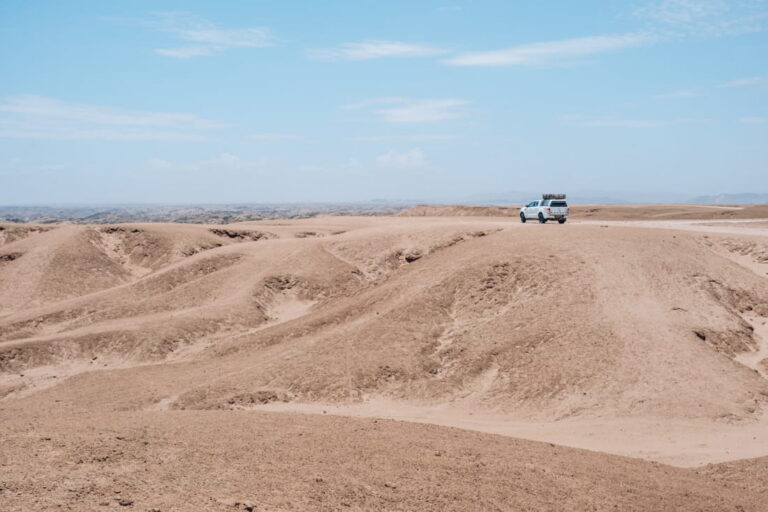

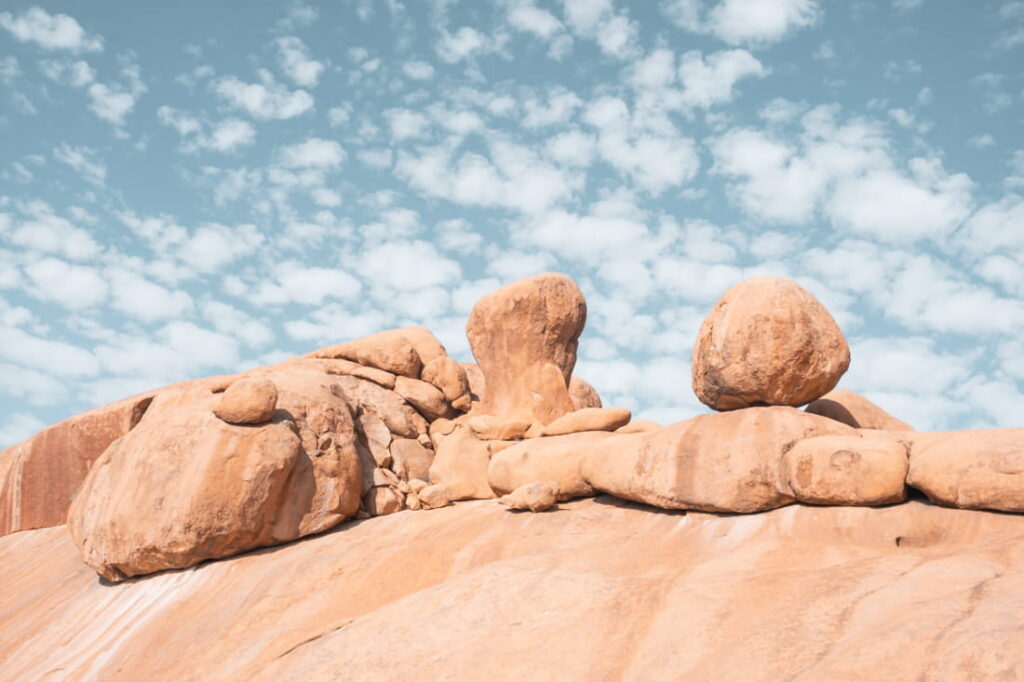
Spitzkoppe is often called “the Matterhorn of Namibia“. And it is easy to see why. These granite peaks rise straight out of the flat Namib desert plains and create one of the most stunning landscapes in inland Namibia.
The place is often skipped by travelers who are on a tight schedule. But if you are a photography, camping or hiking lover, we assure you are going to love this place! Camping right next to the giant boulders, hike to ancient rock art or catch the unforgettable sunset. It makes Spitzkoppe an absolute must-visit on any Namibian road trip.

Some of the links on this blog are affiliate links. This means if you click on a link and purchase, we receive a small commission at no additional cost to you. The affiliate links concern only products and services we appreciated highly and trust. This means the views and opinions expressed in this post are purely our own. For more information, read our privacy and cookie policy.
Table of Contents
Get the Spitzkoppe vibes by watching our video
Where to Stay in Spitzkoppe
Spitzkoppe Community Rest Camp
If you are camping as we were, staying inside the park at the Spitzkoppe Community Rest Camp is by far the best experience. The campsites here are spread out over a large area around the base of the rocks. As you often cannot see the other campers due to the vastness of the camping site, this place offers a true wilderness vibe.

- Camping rates: The daily conservation fee for Spitzkoppe is 180 NAD per person. Next to that, you pay 300 NAD per person for a camping spot.
- Facilities: Keep in mind that the campsites are minimal. Except a basic dry/drop toilet and a built-in fire pit, don’t expect anything else. There is no electricity or running water at the campsites. However, near the main entrance/reception area, you can find hot showers, flush toilets and water. At the entrance, there is also a restaurant and bar. Here you can pay by card and you can charge your camera or smartphone.
- How you choose your spot: When you arrive, you check in at reception, pay your fee, and receive a map with all the numbered campsites. A crucial detail: the reception does not track which specific sites are occupied. As the campsites are located far apart from each other, you sometimes have to drive around to find an open spot.
- Our experience: We arrived relatively late on our first day, which meant we had to drive around for quite some time to find an unoccupied site. That night, we stayed at camping spot number 15. The next morning, once we understood the layout of the campsite better, we moved to a more quiet and isolated spot.
- Best campsites at Spitzkoppe: All the campsites with number 8, 9, 10 and 11: These campsites are located on the western side of the site. They also offer the best place to catch the sunset without having to drive back in the dark. If you want to stay at one of these campsites, it is best to arrive here in the early afternoon. The second night, we stayed at campsite 9A.


Lodges and hotels near Spitzkoppe
If you are not camping, you can stay at some stunning accommodation. Keep in mind that even when you stay outside the conservation area, you always have to pay a daily conservation fee of 180 NAD to enter the area.
Spitzkoppen Lodge
This lodge is located in the most stunning location, with views over the Spitzkoppe area. It offers luxury chalets built right into the granite boulders. There is a pool to cool down from the heat and a restaurant. An excellent choice if you want comfort without leaving the scenery behind. Prices vary around 13.000 to 16.000 NAD per night for two persons. Expensive, but in this scenery totally worth it!
Check availability and current prices directly at BOOKING.COM


Spitzkoppe Cabin Camp
A great alternative if you are looking for a more affordable alternative. This place offers well-kept bungalows and canvas tents with shared bathrooms. Prices vary around 3.000 NAD per night for two persons.
Check availability and current prices directly at BOOKING.COM


What to do in Spitzkoppe
Take a guided hike
To protect the fragile ancient rock paintings, most major trails in Spitzkoppe require a local guide. You can check times or arrange private guided tours directly at reception.

Guided hike to Bushman’s Paradise
This is a hike that is organized every day, at certain time slots during the day. You can ask for the exact times at the reception. The meeting point is indicated on the map of the area and you meet the guides at the designated spot. Afterwards, the guides ask for a small donation.
- The hike: Don’t expect a long hike. The trail starts with a steep climb up a flat granite rock and once you are up, it is only a short distance to the rock art. Sturdy shoes with good grip and plenty of water are however mandatory. There are metal poles with cables installed to help you pull yourself up the steepest section.
- The highlight: At the top, you reach a sheltered cave area with rock art left behind by ancient San hunters. Our guides provided clear context about the paintings, the pigments used, and the life of the San people. And as a bonus: Because you are on top of the rocks, you get panoramic views over the surrounding plains and granite formations.


Guided excursion to the ‘Golden Snake’
After Bushman’s Paradise, we teamed up with a small group of other travelers to split the cost of a second guided trip deeper into the park. The guide hopped into our car and took us past a second park gate to a quiet, narrow canyon section.
- The highlight: After walking through the rocky gorge, the guide showed us rock art depicting a “Golden Snake” as well as ancient shamans.
- Wildlife: On our way back through this section, our guide also spotted a few resident zebras roaming the domain, which was a great bonus. We did already see a lot of zebra’s during our time in Etosha, but for other travelers, this were their first zebra’s ever.


Visit the arch of Spitzkoppe
The natural granite arch here in Spitzkoppe is probably the place that is most often photographed place. And it is easy to get there! The arch frames the surrounding landscape perfectly, making it an incredible spot for photography early in the morning or late in the afternoon.


How to get there: Head toward campsite 5 and scramble up the smooth rock behind this campsite. There are no signs to show you the way, but that is part of the fun! Just continue and you’ll quickly see the arch. It’s a short, easy walk, but watch your step on the smooth rock face.
Walk the trail in between camping spots
Don’t just drive between locations. We also took the time to hike along the dirt roads and pathways linking the different campsites. Walking through the valley gives you a proper scale of these peaks and allows you to experience this place at your own pace.


Watch the sunset from the boulders
This is definitely one of our favorite things to do in Spitzkoppe. Watch the sun dip below the horizon from the granite rocks. You’ll see the rocks turn vibrant in different shades of orange, red, and pink.
How to do it: Pick a boulder near your camp, climb up to a safe point, bring a cold drink, and enjoy the show!

Stargazing
With zero light pollution and wide open desert skies, Spitzkoppe offers some of the clearest night skies in Southern Africa. On clear, moonless nights, the Milky Way can be seen directly over the giant granite boulders.
Pack to Life tip: Bring a headlamp with a red-light mode so you don’t ruin your night vision or interrupt other stargazers.
What is the best time to visit Spitzkoppe?
The best season to visit Spitzkoppe is from May to October (dry season). This period offers cooler daytime temperatures for hiking and clear nights for stargazing. Summer (November to April) can bring extreme heat and sometimes rainstorms that can make climbing smooth rocks slippery. We visited Spitzkoppe during early November.
How many days do you need for Spitzkoppe?
One night at Spitzkoppe is enough to see the highlights, but staying two nights allows you to secure a better campsite on day two and enjoy this place without rushing. We spend two nights here and we were happy we could witness the sunset here a second time.

How to get to Spitzkoppe?
Spitzkoppe is located in the Erongo region in inland Namibia, halfway between Swakopmund and Usakos.
- From Swakopmund: Take the B2 inland toward Usakos for about 100 km, then turn left onto the D1918 gravel road, followed by the D3716. Expect to drive around 1,5 to 2 hours.
- From Windhoek: Drive west via the A1 and B2 through Okahandja and Karibib to Usakos. Just past Usakos, turn right onto the D1918 gravel road. This drive will take about 3,5 to 4 hours
Pack to life tip: we visited Spitzkoppe on our way from Etosha to Swakopmund. We had an in-between stop at Twyfelfontein before heading to Spitzkoppe. If we would do it again, it would be exactly the same!

A standard car can reach Spitzkoppe in dry conditions via the gravel roads, but a 4×4 or high-clearance car is recommended for driving more comfortably.
Practical tips we learned from our time in Spitzkoppe
- Water and supplies: Stock up on groceries and drinking water in Swakopmund or Usakos beforehand. The small shops near the reception only sell basic snacks and cold drinks.
- Cash is king: Always bring enough cash in Namibian Dollars (NAD) or South African Rand (ZAR) for campsite fees or guide tips.
- Guide tipping: Tipping your local guide is standard practice here and directly supports the local community! Plan for around 100–150 NAD per group for a guided walk.
- Protect yourself to the sun and heat: The granite boulders reflect the heat and it can get extremely hot in Spitzkoppe. Schedule your hikes for early morning or late afternoon. Make sure to always carry enough water.


Our checklist for Spitzkoppe
- Sturdy hiking shoes with good grip. Also keep in mind that there are snakes and scorpions at this site, so watch where you are walking!
- Headlamp or flashlight for navigating basic campsites at night. A headlamp with a red light is ideal for stargazing.
- Power bank or solar panel as there is no electricity at campsites.
- Trash bags to take your garbage with you. You must pack out everything you pack in.
- Firewood

We hope this post convinced you not to skip Spitzkoppe and add it to your itinerary for Namibia. We are convinced you will love it!
Happy travels
Matthias & Mieke
Quick start your holiday with the help of our trusted tools
These are the websites we highly recommend to plan your next trip. We use them all the time to save money and travel freely! Did you know that by purchasing through our links, you support us at no additional cost. Thank you for your support. ♥️
Find hotels: via booking.com
Find a rental car: via discovercars.com
Find cheap flights: via skyscanner.com
Book tours & attractions: via getyourguide.com
Book a bus / train / transfer: via omio.com—